About this work
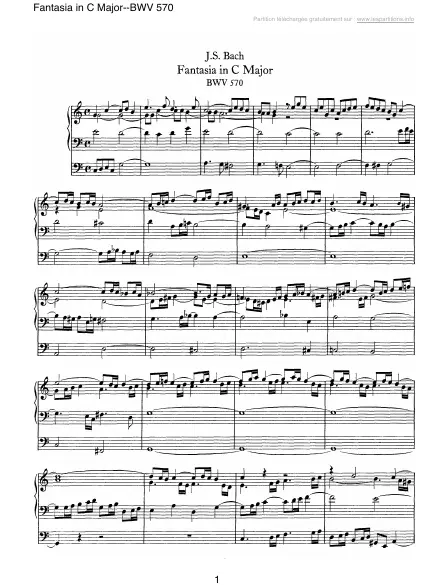
This Fantasia in C major proceeds as continuous counterpoint rather than a succession of chords. Voices answer through imitation, cross and carry their lines beyond bar lines. Clarity therefore depends on voice leading and exact note lengths as much as on volume.
Sequences gradually move the harmony and prepare cadences that organise the journey. Identify which voice launches each figure and which one continues it. The preserved two-stave notation does not isolate an independent pedal part: the actual lines need to be read before deciding how they might be distributed at the organ.
Begin with a restrained registration and a tempo at which every entry remains audible. Practise voices in pairs, then combine them without making the articulation heavier. At cadences, lighten the phrase ending without interrupting the pulse; sequences will then acquire harmonic direction instead of becoming a uniform mechanism.
What the document containsDocument: The document contains 2 pages in PDF format. No MIDI file is currently attached to this historical record. The PDF contains the complete Fantasia on two pages and presents all the writing on two staves.The historical record marks the file as public domain but does not document the editor or exact provenance of this copy. The file preserved by LesPartitions.info can be compared with the reference catalogue. Following that check, LesPartitions.info separates established facts from information that remains incomplete.