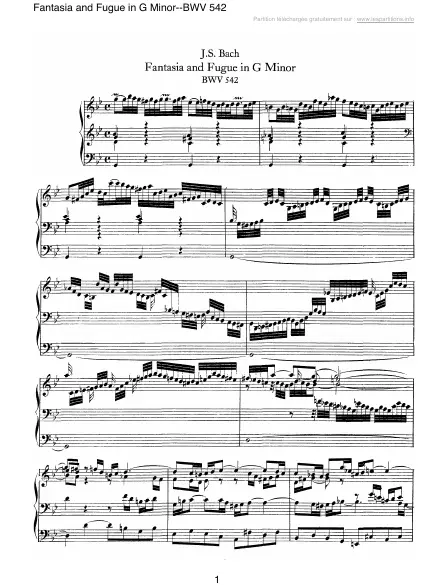
About this work
The Fantasia in G minor proceeds through free gestures, rapid runs, chords and chromatic lines that sometimes approach recitative. Silences and abrupt changes of texture belong to the discourse. Giving them an exact duration is more expressive than maintaining uniform power from beginning to end.
The Fugue is based on a long, dance-like subject whose successive entries gradually build the polyphony. Episodes relax the texture, move through registers and prepare new returns. The pedal part needs its own articulation so that the bass supports the architecture without overwhelming the manual voices.
First separate the rhetorical units of the Fantasia and decide where resonance should genuinely stop. In the Fugue, sing the subject, mark all its entries and practise episodes with a steady pulse. A clear, evolving registration will reveal the formal contrast without turning every change into a theatrical effect.
What the document containsDocument: The document contains 10 pages in PDF format. No MIDI file is currently attached to this historical record. The PDF contains the complete Fantasia followed by the Fugue on three staves and separates pedals from manuals.The historical record marks the file as public domain. The reference Mutopia record points to a public-domain Peters edition without proving that the LesPartitions.info copy exactly reproduces that edition. The file preserved by LesPartitions.info can be compared with the reference catalogue. Following that check, LesPartitions.info separates established facts from information that remains incomplete.