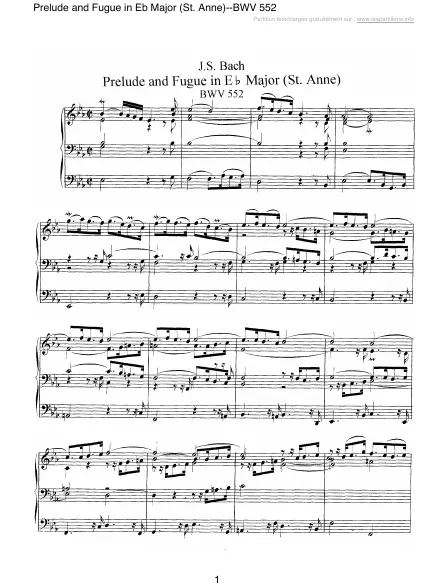
About this work
The prelude opens with the ceremony of a grand French overture, then changes texture several times without losing its axis. Dotted rhythms, more fugal passages, and massive returns must belong to one architecture. Before choosing registrations, locate the principal cadences: they show where the space opens, tightens, or starts moving again.
The fugue introduces three subjects in succession. The first moves in long values, the second circulates more quickly, and the third brings continuous motion. The challenge is to characterise each one without manufacturing three separate pieces. Practise entrances with distinct articulation, then observe how the subjects combine. The pedal must remain a voice rather than an automatic foundation effect.
The nickname “St Anne” comes from a resemblance between the first subject and an English tune; it is not a programme supplied by Bach. Interpretation is better grounded in what the score actually shows: proportion, increasing density, and returning material. A broad registration is welcome, but contrapuntal clarity determines the result.
What the document containsthe prelude and fugue for organ;an 18-page PDF;no accompanying MIDI file.The engraving joins the two panels that frame the original collection.