About this work
This Rondo. Allegro scherzando closes the Piano Concerto No. 1 in C major, although the work’s number hides a less straightforward history. Beethoven had begun the B-flat concerto now known as No. 2 before this one; the C-major concerto became No. 1 because it was published first. The Beethoven-Haus dates the earliest sketches to 1793, a first complete version to late 1794 or early 1795, and further revisions through 1801. Franz Gerhard Wegeler recalled that Beethoven was still completing this rondo two days before the probable première on 29 March 1795, with copyists carrying away each finished sheet as it became available.
The movement nevertheless opens without historical ceremony: the piano alone launches a nimble refrain built from repeated notes, small leaps and accents that keep shifting the point of balance. The orchestra does more than repeat the tune. Each return changes its light, passes fragments between strings and winds, or lets a recognisable cell anticipate the complete refrain. This habit of allowing the listener to recognise the theme before it fully returns gives the rondo its continuity and humour; the form feels more fluid than a simple alternation of refrain and episodes.
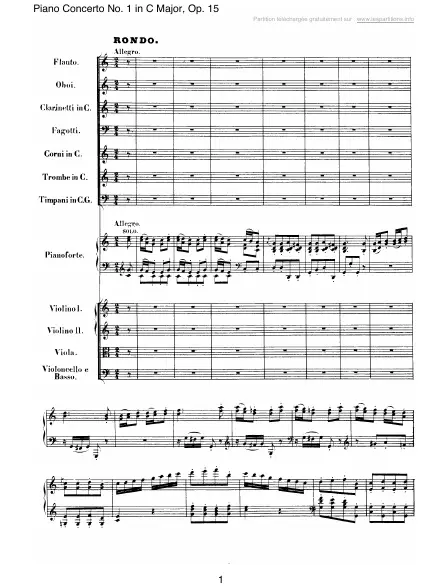
The episodes gradually widen the soloist’s range through semiquaver runs, octaves, repeated chords and moments when the piano briefly accompanies replies from the woodwinds. The full score shows flutes, oboes, clarinets, bassoons, horns, trumpets and timpani working around the strings. Much of the character lies in a very short handover or an entry placed off the beat; if the soloist keeps everything in the foreground, the conversation vanishes. In practice, accents, the ends of runs and shared breaths are worth fixing before speed is added.
The ending concentrates Beethoven’s taste for surprise. After an extended rise in virtuosity, the piano reaches several fermatas and a short cadenza. The final page then interrupts the movement with an unexpected Adagio: the orchestra holds time still, as though a solemn conclusion were about to begin. Tempo I returns almost at once, the repeated notes start up again, and the tutti closes the work in a few decisive bars. This mock slowing is not a joke pasted onto the music; it sums up a finale that repeatedly reshapes the listener’s expectation before recovering its momentum.
What the document containsDocument: The document contains 28 pages in PDF format. No MIDI file is currently attached to this historical record. This full score contains the third movement only. Its heading reads simply Rondo. Allegro, while the Beethoven-Haus catalogue gives the complete marking Rondo. Allegro scherzando; the final page contains the Adagio interruption, cadenza and Tempo I return described in the notice.The historical record marks the work and file as public domain but does not document the editor or exact provenance of this copy. The file preserved by LesPartitions.info can be compared with the reference catalogue. Following that check, LesPartitions.info separates established facts from information that remains incomplete.