Free sheet music
Symphony No. 1 in C major, Op. 21 — IV. Adagio, Allegro molto e vivace
About this work
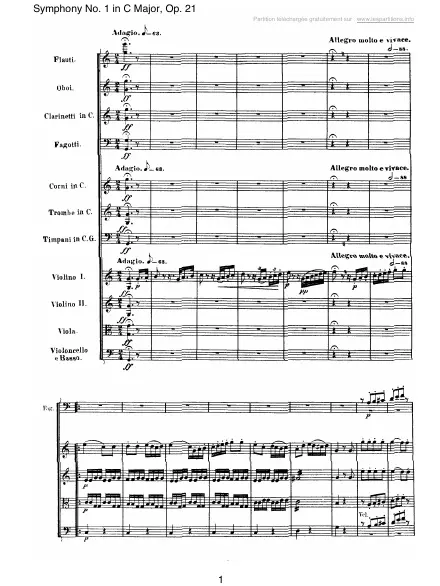
The finale of Beethoven’s First Symphony opens like a joke: a scale hesitates, adds a few notes, and finally releases the Allegro molto e vivace. This slow beginning is more than a preface. It introduces the rising material that feeds much of the movement once the full tempo arrives.
In the score, mark fragments of the scale and the replies that circulate between strings and winds. Full orchestral passages draw strength from rhythmic coordination, but lighter episodes require a real conversation. Transitions become clearer when they are read in groups of bars instead of as streams of fast notes.
Rehearse the introduction first, keeping its rests tense and its shared attacks exact. In the Allegro, bow strokes and wind articulation should be short enough to leave space around details. The movement needs to quicken the listener’s attention without sacrificing contrast or the humour established at the beginning.
What the document containsContents: the complete orchestral score of the fourth movement from Symphony No. 1, Op. 21, spanning 27 pages, with a listening MIDI.This OpenScore Orchestra engraving, preserved in Hauptstimme, is available under CC0 1.0. LesPartitions.info checked its notation and playback and inspected all 27 pages.