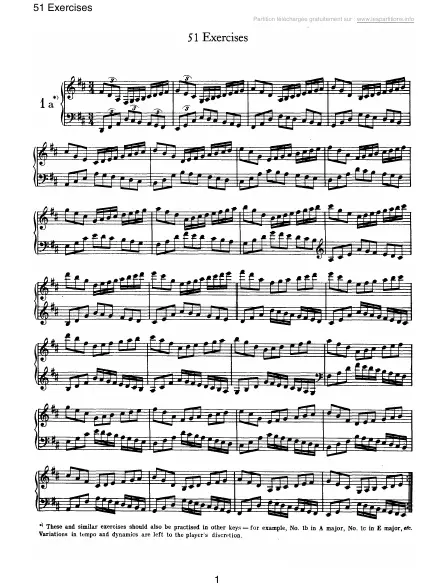
About this work
These exercises are not concert music in disguise. Brahms isolates problems of coordination, extension, repetition, and finger independence. Their value lies in that precision. Playing the whole volume from beginning to end, fast and loud, produces more fatigue than learning. Choose the gesture that serves the repertoire currently on your desk.
Work slowly, with a reduced range of motion and regular breathing. As soon as the forearm locks or the hand strains to hold a position, stop, release, and simplify the passage. Vary rhythms only when that makes the movement clearer. A metronome measures stability; it should not become the starting pistol for an imaginary daily race.
A short session is enough. Alternate separate hands, very small groups, and an immediate return to a musical phrase containing the same problem. That test reveals whether the exercise actually improves playing. Consistency matters more than quantity, and pain is never part of the programme. Brahms asks a great deal of the fingers, but he does not ask them to file a complaint.
What the document containsthe collection of technical exercises for solo piano;a 53-page PDF;no accompanying MIDI file.The material is intended for focused practice and is not a complete progressive method.