About this work
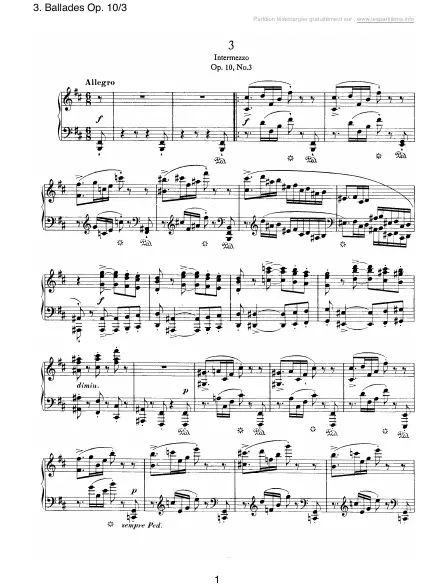
This Ballade also bears the indication Intermezzo, and its manner confirms that ambiguity. It does not tell an explicit story like the first piece in the cycle. Instead, it proceeds through contrasts: nervous gestures in the lower register, lighter answers, sudden silences, and displaced accents. Its relief depends far more on rhythmic precision than on constantly dramatic volume.
Begin by stabilising the short figures without pedal. The hands should answer with the same articulation even when they occupy distant registers. Then add brief pedal to colour harmonies without joining what Brahms separates. Irregular accents become expressive when the underlying pulse remains perceptible.
The central section broadens the song and changes the breathing. Do not slow it enough to interrupt the movement; it should seem to open another piece inside the same piece. On the return, the initial gestures may sound darker without becoming heavier. Keep the silences active, since they belong to the rhythm and prepare each shift of register.
What the document containsthe third Ballade for solo piano;a 4-page PDF;no accompanying MIDI file.The file isolates this piece from the complete cycle of four Ballades.