About this work
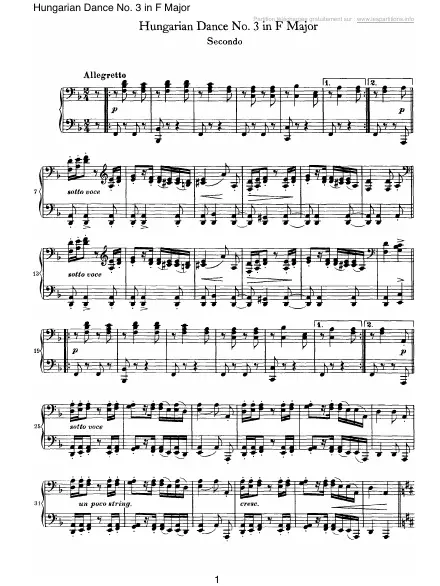
The third Hungarian Dance begins as a graceful Allegretto in F major. A short upbeat launches compact phrases, often punctuated by accents that add profile without weighing down the step. The primo presents the line and its sotto voce replies; the secondo maintains detached bass notes and figures that carry motion between the main supports.
At bar 37 the character turns into a fortissimo vivace. Chords become more direct, registers spread apart and both parts join the same surge. A poco a poco diminuendo then leads back to Tempo I. This three-part design occupies 72 bars; its success depends less on virtuosity than on clear contrasts and a convincing return.
Practise the opening quietly, treating accents as brief impulses. Prepare the vivace in two-bar blocks with simultaneous chords and light pedal. During the diminuendo, preserve rhythm and direction while gradually reducing the mass of sound until the original articulation returns. The reprise should feel recognised rather than merely repeated.
What the document containsDocument: The document contains 4 pages in PDF format. No MIDI file is currently attached to this historical record. The four-page PDF gives all 72 bars in separate secondo and primo parts, including the Allegretto, vivace section and Tempo I return.The historical record marks the work and file as public domain but does not document the editor or exact provenance of this copy. The file preserved by LesPartitions.info can be compared with the reference catalogue. Following that check, LesPartitions.info separates established facts from information that remains incomplete.