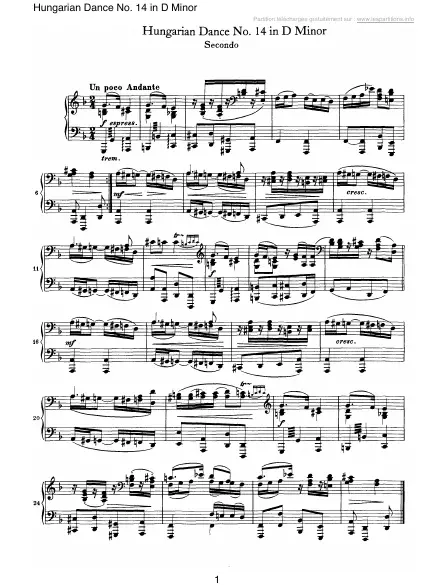
About this work
Brahms’s fourteenth Hungarian Dance is striking for its restrained step. The marking Un poco andante takes this D-minor dance away from the brilliant rush often associated with the collection. Its melody moves with gravity, then quickens in small surges. At four hands, the character depends less on a grand effect than on shared breathing and shared rubato.
Before playing together, decide who leads each phrase opening. The primo often carries the more exposed line, but the secondo determines stability through the bass and harmonic supports. An accompaniment that is too heavy traps the melody; a bass that is too cautious removes the ground beneath it. Begin without pedal to agree on note lengths, then decide exactly who pedals and at which harmonic changes.
Ritardandos must be prepared through gesture and breath, not announced after the event. In repeats, temporarily reverse your listening roles: let the primo follow the bass while the secondo sings the melody inwardly. The exercise quickly reveals displaced accents. Once both parts share the same flexible pulse, the twenty-seven bars form a complete narrative rather than a slow miniature.
What the document containsHungarian Dance No. 14 in D minor;the 2-page version for piano four hands;no accompanying MIDI file.The layout places the primo and secondo parts above one another for duet reading.