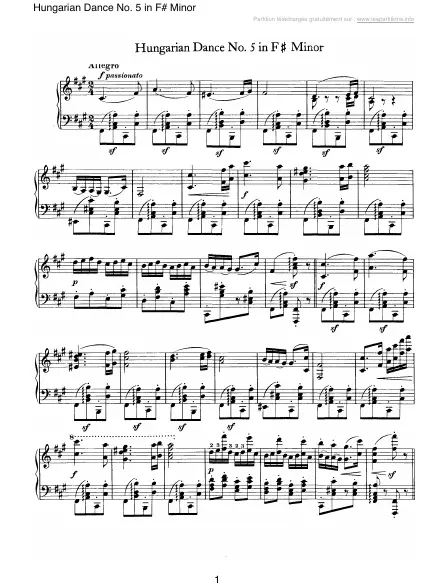
About this work
The fifth Hungarian Dance thrives on changes of pace. A phrase may press forward, brake suddenly, then set off again as if the ground had shifted beneath it. In the piano version in F-sharp minor, the contrasts of tempo and accent must be clear enough to shape the dance, yet connected enough to form a single trajectory rather than a succession of famous effects.
First establish a reference pulse for each large section. The slowdowns then become measured departures, and the return to tempo no longer depends on a momentary impulse. Practise the melody while naming its main stresses, then add the accompaniment with short, elastic chords. Octaves and rapid passages become clearer when the wrist remains free after every attack.
Repeats invite changes of colour: lighter, sharper or more distant, rather than automatically louder. In quick passages, think in groups directed towards an arrival; note by note, the energy disperses. Preserve the silences as well. They belong to the rhythm and give each restart its effect. Filling them with pedal is rather like revealing the fall before placing the banana skin.
What the document containsThe fifth Hungarian Dance in F-sharp minor, in a version for solo piano.One 3-page PDF score.No MIDI file is provided.The frequently heard orchestral version is a separate arrangement.