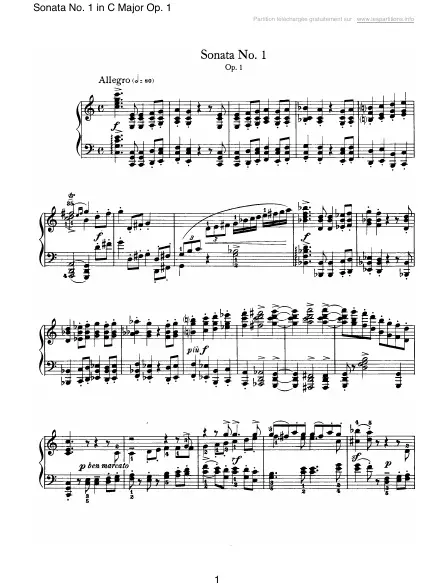
About this work
This second historical record for the Op. 1 Sonata leads to the same file as record 44. It can still provide a useful practice map for a forty-nine-page work whose energy must be budgeted. The opening Allegro sets out very broad chords, yet their power depends on the more connected replies and releases that follow. Permanently hard attack would remove the very relief the movement needs.
The Andante takes a German melody as the basis for variations. The Scherzo, Allegro molto e con fuoco, needs a sharper articulation, while the Finale combines motor rhythm, passagework and broad chordal returns. The four movements therefore require different colours. Continuity comes from motifs and bass direction, not from an unchanging sound.
Build the piece in short sections, then join them in pairs while preserving the opening tempo of each unit. Prepare chord shapes above the keyboard and release weight as soon as the sound is made. Listen through every sustained tone in the slow variations. In the Finale, prevent rapid figures from pulling the bass forward: the bass remains the safest guide for reconstructing the long phrase.
What the document containsDocument: The document contains 49 pages in PDF format. No MIDI file is currently attached to this historical record. These 49 pages exactly duplicate the PDF attached to record 44; no additional musical content is present.Both historical URLs serve a file with the same checksum. The reference catalogue documents the work, its dedication to Joseph Joachim and its 1853 first publication, but does not identify this digital engraving. The file preserved by LesPartitions.info can be compared with the reference catalogue. Following that check, LesPartitions.info separates established facts from information that remains incomplete.