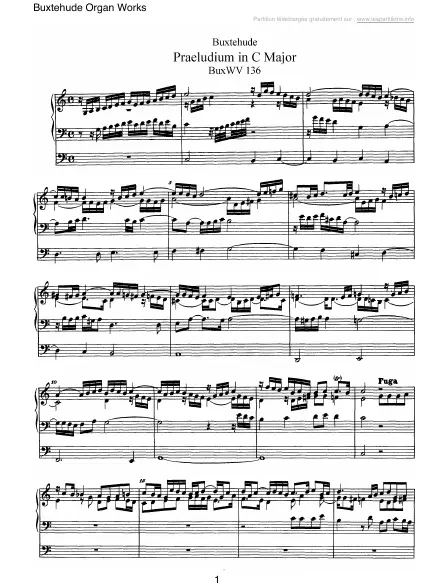
About this work
Buxtehude's organ preludes delight in changing ground without warning: a free gesture opens the space, a fugal section tightens the argument, then a flourish or cadence releases the improvisation again. The first nine pieces in this volume show the stylus phantasticus in action. Their form relies less on a symmetrical plan than on the balance between freedom, counterpoint and the return of the pedal.
Before choosing the stops, draw the structure of each prelude. Circle the subjects, free episodes and extended pedal points; this will show where the touch or density can change. In the fugues, use an articulation that distinguishes each entry without chopping up the phrase. The rapid passages need a free gesture and an inner pulse even when they sound improvised.
The pedalboard is not merely a foundation. It can launch a motif, open a new register or prepare a spectacular cadence. Practise its entries separately, then restore them while listening to the dialogue with the hands. One registration may suit a short piece, but the complete sequence calls for deliberate contrasts. There is no need to change the entire organ on every page: a few clear colours are enough when the form remains audible.
What the document containsThe first nine preludes of the group announced on this page.One 48-page PDF score for solo organ.No MIDI file is provided.The rest of the group is available separately in the catalogue.