About this work
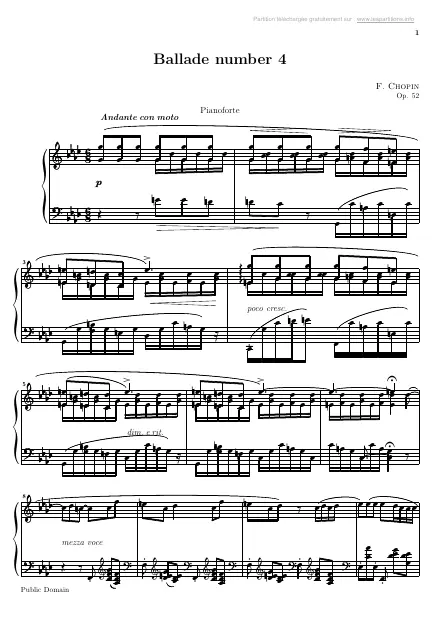
Chopin’s fourth Ballade begins almost under its breath. Its theme returns several times, never quite unchanged: an inner voice wakes, the harmony tightens, and the accompaniment gathers motion. This continuous transformation gives the piece its shape. If every return is treated as a straightforward repeat, much of the narrative disappears.
First trace the melody, bass, and inner parts separately. They do not always breathe in the same place. Bring them together without allowing the right hand to cover what happens in the middle of the keyboard. Contrapuntal passages need a very stable pulse; rubato may broaden an arrival, but it should not pull the voices apart.
The coda is not a sprint attached to the ending. It depends on the energy gathered earlier. Prepare its chords, shifts, and runs in small groups, then rebuild longer trajectories. The few suspended chords before it are crucial: their silence concentrates the tension and makes the final eruption far more striking.
What the document containsthe Ballade for solo piano;a 21-page PDF;a MIDI file for reference listening.The material presents the complete work in an older digital engraving.