Free sheet music
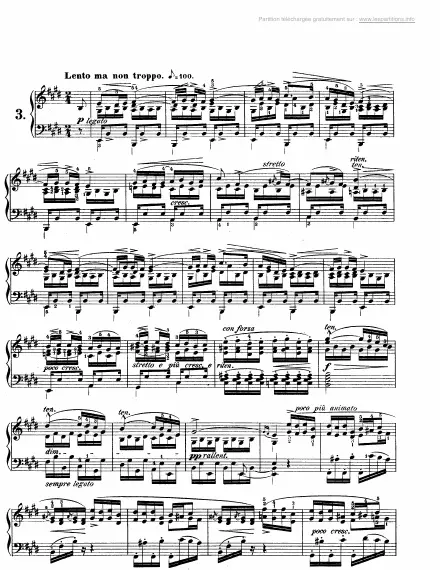
Étude Op. 10 n°3 « Tristesse »
About this work
Chopin’s Étude, Op. 10 No. 3, begins with a line that the right hand must make sing from within several voices. The nickname “Tristesse,” added after Chopin, cannot sum up the music: its restrained tenderness gives way to a tense central section of chords and far more abrasive chromatic motion.
In the opening, practise the melody, inner voice, and bass separately. Then combine them while keeping the hand supple: the melody needs continuous weight, while the surrounding notes remain close to the keys. Pedalling should connect the harmony without blurring changes or turning every phrase into a uniform haze.
For the central section, first reduce the tempo and seek alignment between both hands. Accents arise from the direction of each group, not from tightening on every chord. When the theme returns, avoid treating it as a merely peaceful repetition: the preceding episode has changed how it is heard. A more inward dynamic is enough to make that memory perceptible.
What the document containsthe Étude, Op. 10 No. 3, for piano;a 3-page PDF;an accompanying MIDI file for listening reference.The score gives the complete text of the étude, including its contrasting central section.