About this work
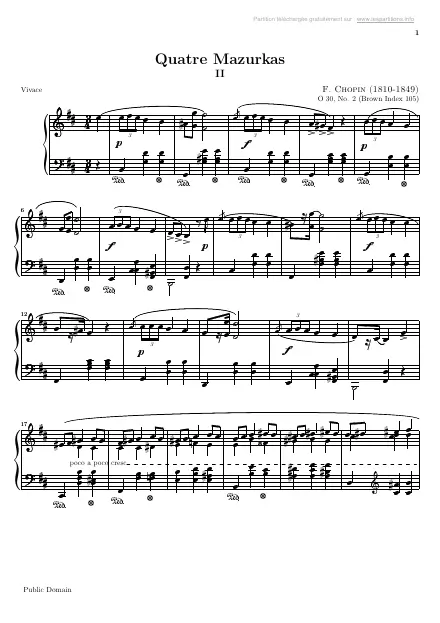
Mazurka Op. 30 No. 2 begins in B minor and 3/4 with a Vivace based more on lift than speed. Short triplet groups launch the melody, often acting as an upbeat towards an accent or sustained note. The left hand replies with widely spaced bass notes and chords. Unless both layers share the same internal pulse, the rhythm comes apart within the first few bars.
Phrases then broaden through chromatic lines, gradual crescendos and transfers of voices between the hands. Returns of the initial motif alternate with more connected passages in which the bass also becomes active. Accents do not all demand greater volume: some show the direction of a cell or briefly displace the point of emphasis within the bar.
Play each triplet as a single gesture leading to its arrival note, then place it above a left hand reduced to bass notes. In chromatic rises, identify chord positions and prepare the next one before leaving the previous one. Practise long crescendos at a moderate tempo while retaining some reserve for their final bars. Pedal can connect the written basses, but it must not conceal changes of voice or thicken repeated chords.
What the document containsDocument: The document contains 3 pages in PDF format. A MIDI file also helps locate the continuity and entries. The PDF has 3 pages and contains the complete B-minor mazurka in 3/4, with a Vivace direction, triplets, pedalling and 64 bars.The PDF is an older Mutopia engraving credited to Peter Dobratz and placed in the public domain. Its former Mutopia record is absent from the current catalogue; the linked IMSLP page is used only to cross-check the work’s identity. The file preserved by LesPartitions.info can be compared with the reference catalogue. Following that check, LesPartitions.info separates established facts from information that remains incomplete.