About this work
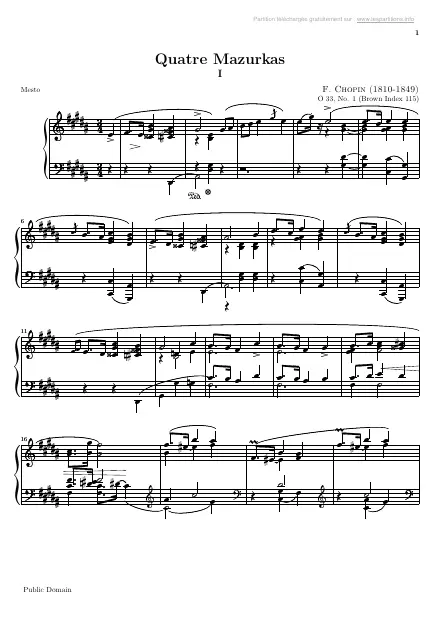
Mazurka Op. 33 No. 1 begins in G-sharp minor and 3/4 with a single upbeat. The direction Mesto and frequent rests give the melody a restrained manner: each motif seems to stop before resuming in another register. Accents sometimes fall on a weak part of the bar and shift its balance. Their weight should remain expressive without turning the dance into a sequence of heavy chords.
An appassionato episode lengthens the lines and increases intensity before the opening phrases return at quieter dynamics. The left hand alternates bass notes, chords and connecting voices, so it is not always a simple accompaniment. Fermatas and final suspensions belong to the structure. Cutting them short removes tension from the restart, while an excessive wait breaks the shared pulse.
Begin with the melody alone, counting rests as precisely as notes. Add the bass without intervening chords so that its lines can be heard. In the central episode, build intensity across several phrases and keep local accents under control. Prepare chords during breaths without stiffening the hand. Decide on a consistent length for fermatas and retain the motion mentally before restarting.
What the document containsDocument: The document contains 3 pages in PDF format. A MIDI file also helps locate the continuity and entries. The PDF has 3 pages and contains the complete G-sharp-minor mazurka in 3/4, with an upbeat, Mesto direction, appassionato episode and 48 bars.The local PDF is an older Mutopia engraving by Peter Dobratz placed in the public domain. The current Mutopia record refers to another engraving of the same mazurka, based on a Schirmer edition and released under CC BY 3.0. The file preserved by LesPartitions.info can be compared with the reference catalogue. Following that check, LesPartitions.info separates established facts from information that remains incomplete.