Free sheet music
Pièces mélodiques Op. 149 n°10
About this work
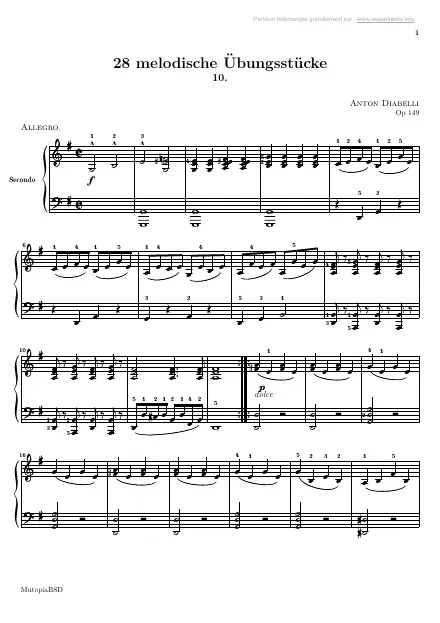
The G-major Allegro is written in 2/2, so each bar must be felt broadly even when quavers multiply. Secondo establishes an ostinato bass and chords that provide the foundation; Primo answers with a wider melody, then scales and repeated notes. The piece gains momentum when those levels remain distinct and the accompaniment does not try to follow every detail of the upper part.
The repeats develop several contrasts. A dolce passage suspends the energy without changing the pulse, then a crescendo gradually draws the parts together. Primo’s scales cross the register while Secondo continues its regular pattern. At the end, forte chords finally gather the texture into one sound. The trajectory therefore moves from a clearly layered texture towards a more collective sonority.
Count in minims and let Secondo play only the bass note on each broad pulse. Primo can then place the scales above that framework, aiming at their destination rather than every intermediate note. In the crescendo, add sound in stages and keep the chords relaxed. Both pianists should also agree on pedalling: too much resonance blurs the ostinato bass, while too little breaks the line. The final cadence should sound prepared by the entire crescendo rather than attached at the end.
What the document containsDocument: The document contains 4 pages in PDF format. A MIDI file also helps locate the continuity and entries. The PDF has 4 pages and presents Secondo and Primo of the G-major Allegro in 2/2 separately.The score comes from the Mutopia Project. The PDF credits its LilyPond engraving and carries its own licence notice; the current Mutopia catalogue preserves the record and editable source. The file preserved by LesPartitions.info can be compared with the reference catalogue. Following that check, LesPartitions.info separates established facts from information that remains incomplete.