Free sheet music
Pièces mélodiques Op. 149 n°13
About this work
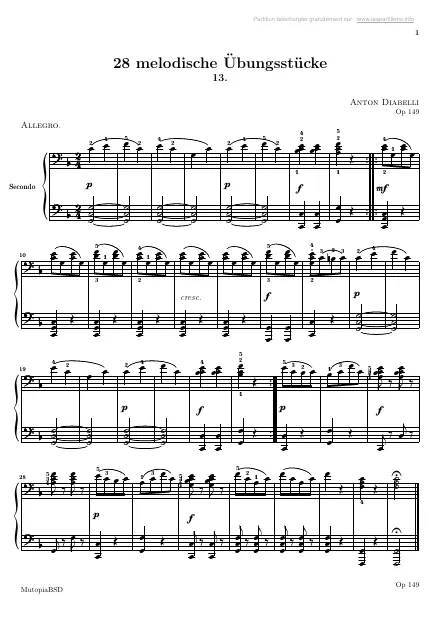
The F-major Allegro in 2/4 is made of short gestures: upbeats, chords, replies and small melodic falls. Secondo often supplies the impulse with a bass note or chord while Primo completes the figure. The music therefore resembles a tightly paced conversation. An imprecise attack matters more than an isolated wrong note because it immediately displaces the other pianist’s answer.
The repeats alternate piano, forte and sforzando. Diabelli sometimes draws the parts together in one rhythm, then separates them again into line and chords. Cadences are brief and return without a written slowing. The character depends on constant spring: silences and upbeats belong to the phrase as fully as the played notes.
Rehearse each upbeat from the preceding silence and count a shared subdivision. Chords must arrive together, but can remain short enough to release the reply. Practise sforzando at moderate volume, seeking simultaneity before accent; it should not stiffen the wrist. At the repeat, retain the same tempo and change only the colour. When both players listen to the end of the other’s gesture, the piece gains a liveliness that the simple notation cannot create by itself.
What the document containsDocument: The document contains 2 pages in PDF format. A MIDI file also helps locate the continuity and entries. The PDF has 2 pages and separates the Secondo and Primo parts of the F-major Allegro in 2/4.The score comes from the Mutopia Project. The PDF credits its LilyPond engraving and carries its own licence notice; the current Mutopia catalogue preserves the record and editable source. The file preserved by LesPartitions.info can be compared with the reference catalogue. Following that check, LesPartitions.info separates established facts from information that remains incomplete.