Free sheet music
Pièces mélodiques Op. 149 n°14
About this work
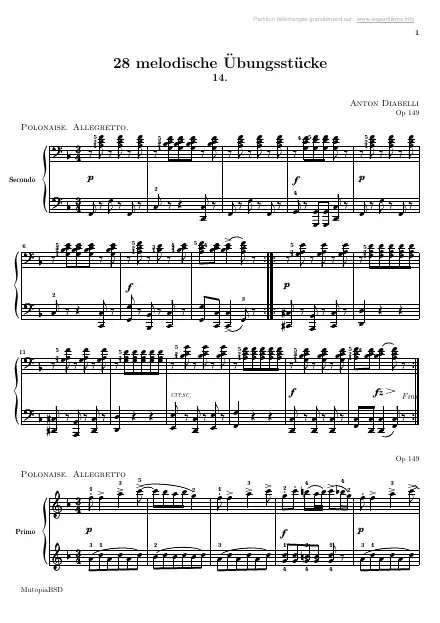
The F-major Polonaise Allegretto uses 3/4 with a dignified dance character: weight on the first beat, dotted rhythms and small upbeats that prevent the frame from becoming heavy. Secondo supplies bass notes and several full chords while Primo draws a more ornamented line. The dance appears when both parts establish a hierarchy among the beats, not when every chord is accented.
The Trio moves to A-flat major and changes colour without abandoning the Polonaise rhythm. Lines become more connected, chords less massive and dynamics more contained. Polonaise da Capo al Fine then returns to the opening section and stops at the marked point. This architecture requires a view of the whole piece: the Trio prepares the return rather than forming a separate miniature.
Practise the dance rhythm by tapping only the first beat and the main upbeats. Secondo should provide weight without holding back the second beat; Primo keeps ornaments within the pulse. In the Trio, lighten the bass and let the slurs create the contrast. Rehearse the transition into the Da Capo: same tempo, a shared breath and an immediately characterised first attack. On returning, a more concentrated sound is enough; there is no need to play louder than on the first pass.
What the document containsDocument: The document contains 4 pages in PDF format. A MIDI file also helps locate the continuity and entries. The PDF has 4 pages: a Polonaise in F major and 3/4, an A-flat-major Trio and Polonaise da Capo al Fine; the parts are separate.The score comes from the Mutopia Project. The PDF credits its LilyPond engraving and carries its own licence notice; the current Mutopia catalogue preserves the record and editable source. The file preserved by LesPartitions.info can be compared with the reference catalogue. Following that check, LesPartitions.info separates established facts from information that remains incomplete.