Free sheet music
Pièces mélodiques Op. 149 n°17
About this work
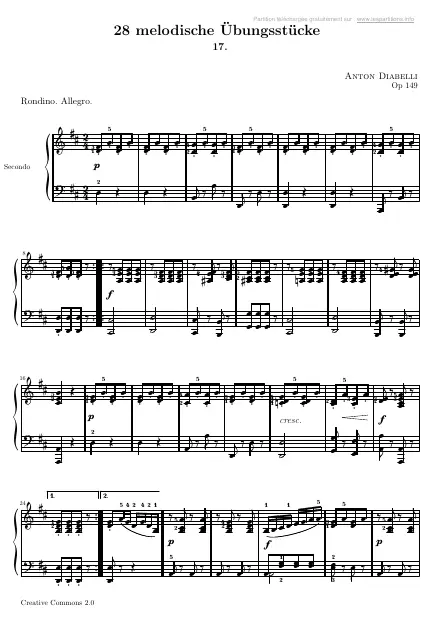
The D-major Rondino Allegro in 2/4 is organised around an immediately recognisable refrain. Secondo establishes it through a rhythm of chords and bass notes while Primo answers with repeated notes and a small melodic curve. Returns are never exact copies: dynamics, register or the distribution between the parts changes and places the motif in a different light.
Between refrains, episodes lengthen the slurs, introduce brief scales and occasionally bring both pianists into the same rhythm. A crescendo prepares the most assertive return, then a piano release restarts the conversation. The form remains clear when episode cadences breathe without excessive slowing; the refrain should emerge from continuity rather than after a stop.
Mark the first note of every refrain in both parts and play only those return points with the preceding bar. Secondo keeps the accompaniment short and clear, while Primo avoids accenting every repeated note. In connected episodes, agree on the phrase’s high point. The crescendo must lead to a precise arrival. Once the form is memorised, remove involuntary ritardandos: listeners should recognise the refrain by profile and colour, not because the pianists announce its return.
What the document containsDocument: The document contains 3 pages in PDF format. A MIDI file also helps locate the continuity and entries. The PDF has 3 pages and separates Secondo and Primo of the D-major Rondino Allegro in 2/4.The score comes from the Mutopia Project. The PDF credits its LilyPond engraving and carries its own licence notice; the current Mutopia catalogue preserves the record and editable source. The file preserved by LesPartitions.info can be compared with the reference catalogue. Following that check, LesPartitions.info separates established facts from information that remains incomplete.