About this work
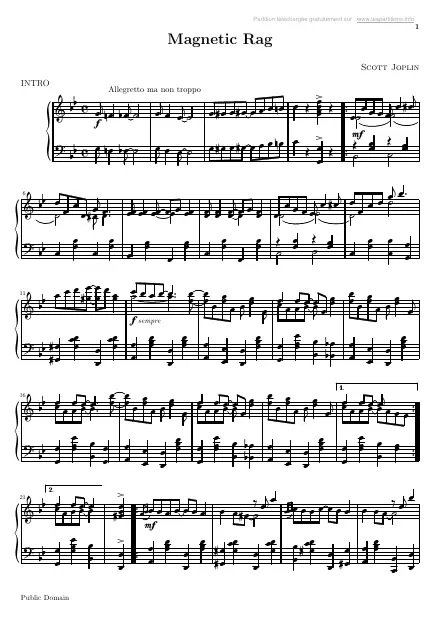
Magnetic Rag is immediately distinguished by its 4/4 metre and the direction Allegretto ma non troppo. In B-flat major, the opening combines chords, syncopations, sustained notes and inner movement. Its texture is more contrapuntal than the rhythmic profile first suggests: some notes must continue to sound while other voices move. Balance therefore depends as much on the length of sounds as on their volume.
Repeated strains explore chromatic figures and shifts of register before a section in D-flat major. Lines cross, chords become denser and the bass does not always use the same pattern. This variety can make the pulse heavy if every beat receives equal emphasis. Four beats should remain perceptible while phrases move in broader groups, particularly as they approach cadences.
Isolate the sustained voices and play them with the bass to hear their harmonic continuity. Add the intervening figures quietly, holding written notes with the fingers rather than relying only on pedal. Practise chromatic passages as short chord connections before returning them to the pulse. In the D-flat section, prepare black-key positions in advance and keep the touch flexible so that the individual voices remain clear.
What the document containsDocument: The document contains 5 pages in PDF format. A MIDI file also helps locate the continuity and entries. The PDF has 5 pages and contains the complete B-flat-major piano piece in 4/4, with repeats, chromatic writing and a D-flat-major section.The score comes from the Mutopia Project. The PDF credits its engraving and carries its own licence notice; the current Mutopia record also preserves the editable LilyPond source. The file preserved by LesPartitions.info can be compared with the reference catalogue. Following that check, LesPartitions.info separates established facts from information that remains incomplete.