About this work
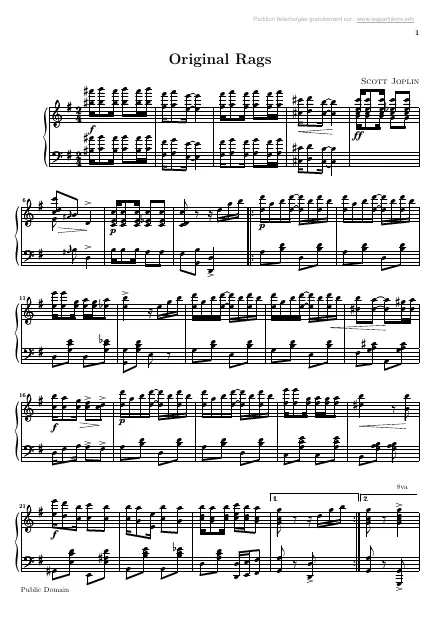
The catalogue record uses the title Original Rag, while the PDF is headed Original Rags. The piece begins in G major and 2/4, combining a syncopated right hand with alternating bass notes and chords in the left. At the first repeat, the score asks for a piano first ending and a forte second ending. This contrast offers a useful clue: the return is not a copy but a fresh presentation of the same material.
Later strains pass through C major and D major before G returns. The writing alternates continuous runs, detached chords, octaves and replies between registers. Near the end, the direction Brillant calls for greater sparkle rather than uncontrolled acceleration. A clear form depends on characterising these textures and preserving a stable bass, especially when the right-hand figures become denser.
Prepare each repeat with a precise balance: light articulation and restrained dynamics the first time, then a firmer attack without extra left-hand weight. Isolate key transitions from two bars before to two bars after each double bar. In running passages, choose fingering that leads towards the arrival chord. Keep some dynamic reserve for the final Brillant so that it genuinely stands apart from the forte sections already heard.
What the document containsDocument: The document contains 5 pages in PDF format. A MIDI file also helps locate the continuity and entries. The PDF has 5 pages, is headed Original Rags and contains the complete G-major piece in 2/4, with sections in C and D major and a Brillant conclusion.The score comes from the Mutopia Project. The PDF credits its engraving and carries its own licence notice; the current Mutopia record also preserves the editable LilyPond source. The file preserved by LesPartitions.info can be compared with the reference catalogue. Following that check, LesPartitions.info separates established facts from information that remains incomplete.