About this work
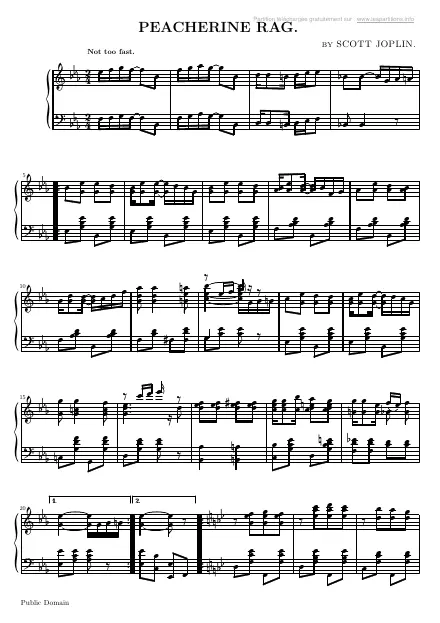
Peacherine Rag opens in E-flat major and 2/4 under the direction Not too fast. Its first motif is short and light, immediately answered by syncopated chords. The left hand provides the alternating bass-and-chord pattern, but its role is not merely metric: the direction of the bass prepares each harmonic change. The character remains lively when every gesture is accurate, even at a moderate tempo.
Repeated strains lead towards B-flat major and then A-flat major, with returns to E-flat. Melodic figures turn into denser chords, shifts of register and short replies. Contrast is built into this variety of writing. If every section receives the same touch, the sequence can feel long; articulation suited to each motif instead reveals the proportions and recurring ideas.
First establish the left hand at a speed that keeps its leaps quiet and flexible. Practise the opening motif towards its final note, then add the chords without an extra accent. At key changes, prepare fingering during the bar before the double bar. In vertical passages, release the wrist after each chord to preserve momentum. Keep the same tempo through repeats and use dynamic balance, rather than speed, to renew their character.
What the document containsDocument: The document contains 4 pages in PDF format. A MIDI file also helps locate the continuity and entries. The PDF has 4 pages and contains the complete E-flat-major piano piece in 2/4, with repeats and sections in B-flat and A-flat major.The score comes from the Mutopia Project. The PDF credits its engraving and carries its own licence notice; the current Mutopia record also preserves the editable LilyPond source. The file preserved by LesPartitions.info can be compared with the reference catalogue. Following that check, LesPartitions.info separates established facts from information that remains incomplete.