About this work
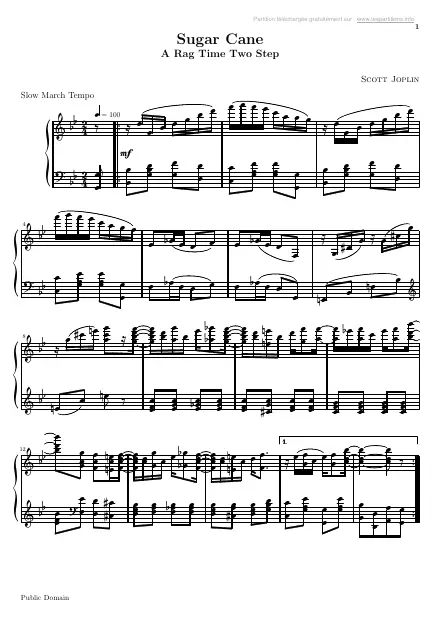
Subtitled Rag Time Two Step, Sugar Cane is in B-flat major and 2/4, beginning with an upbeat under the direction Slow March Tempo. The right hand spans broad arpeggios, octaves and chords across several positions while the left maintains an alternating bass-and-chord pattern. The visual breadth should not create tension: every transfer is prepared during the release from the previous gesture.
Repeated strains change register and density before an E-flat-major episode introduces another group of figures. Chromatic transitions connect these blocks and require accurate harmonic reading. The pulse needs enough firmness to support syncopations and enough flexibility to let arpeggios unfold. Arrival chords provide direction; the intervening notes are not all accents.
Identify the right hand’s extreme positions and first play only the opening and final note of each route. Fill in the arpeggio afterwards with one continuous arm movement. In the left hand, practise leaps without pedal and aim for the bass before placing the chord. Group notes by harmony rather than by beat in chromatic transitions. Reserve pedal for passages where it genuinely connects the sound, then check that changes of section remain clean.
What the document containsDocument: The document contains 4 pages in PDF format. A MIDI file also helps locate the continuity and entries. The PDF has 4 pages and contains the complete B-flat-major piano piece in 2/4, with an upbeat, repeats, chromatic transitions and an E-flat-major section.The score comes from the Mutopia Project. The PDF credits its engraving and carries its own licence notice; the current Mutopia record also preserves the editable LilyPond source. The file preserved by LesPartitions.info can be compared with the reference catalogue. Following that check, LesPartitions.info separates established facts from information that remains incomplete.