About this work
The A-major Concerto K.622 is one of Mozart’s last completed works. He wrote it in 1791 for the Viennese clarinettist Anton Stadler, who had developed a basset clarinet extending down to written low C. The concerto survives only through printed parts from the early nineteenth century; the autograph source is lost. The New Mozart Edition therefore presents both a reconstruction for basset clarinet and the traditional adaptation for ordinary A clarinet. This distinction between the original project and the transmitted version is essential to understanding the solo line.
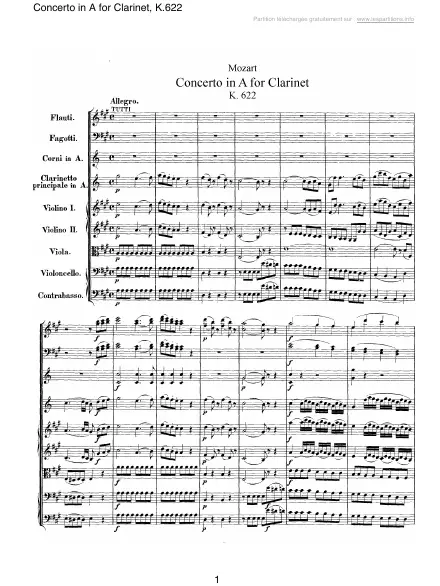
The Allegro opens softly in the strings, soon joined by two flutes, two bassoons and two horns. The principal clarinet recasts the theme, then explores its available range through arpeggios, scales and connected lines. The orchestra is not a passive frame: bassoons and violins imitate the soloist, flutes brighten the upper register and forte returns give firm architecture to freer episodes. Passages written for the original instrument’s low extension are nevertheless raised in this traditional version.
The D-major Adagio begins directly with the soloist above regular string quavers. Winds then enter as extensions of the breath, and silences become part of the phrase. The Rondo Allegro returns to A major with a flexible 6/8 refrain. Its episodes oppose rapid runs, sudden dynamic changes and long lines in the lower register; the form remains clear because each return of the refrain receives a slightly different orchestral colour.
The performer must first decide which version is being played: traditional A clarinet, as in this PDF, or a basset-clarinet reconstruction. In the Allegro, changes of register should retain the same line quality. The Adagio requires shared releases with the strings and breaths that do not break the pulse. In the Rondo, feel two broad beats and prepare piano-forte contrasts; the refrain’s grace should never become hurried.
What the document containsDocument: The document contains 58 pages in PDF format. No MIDI file is currently attached to this historical record. The PDF is a complete 58-page full score: Allegro, Adagio and Rondo. Allegro. It is the traditional version for principal clarinet in A, two flutes, two bassoons, two horns and strings, not the basset-clarinet reconstruction.The historical record marks the work and file as public domain but does not document the editor or exact provenance of this copy. The file preserved by LesPartitions.info can be compared with the reference catalogue. Following that check, LesPartitions.info separates established facts from information that remains incomplete.