About this work
The supposed Concerto K.412 actually joins two different states. The D-major Allegro is by Mozart; the Rondo derives from an outline in which Mozart carried the horn part to the end while leaving the accompaniment unfinished. Franz Xaver Süssmayr later supplied a new orchestration, catalogued as K.514. The New Mozart Edition dates Mozart’s two movements to 1791 and stresses that they never formed a complete concerto with a slow movement during the composer’s lifetime.
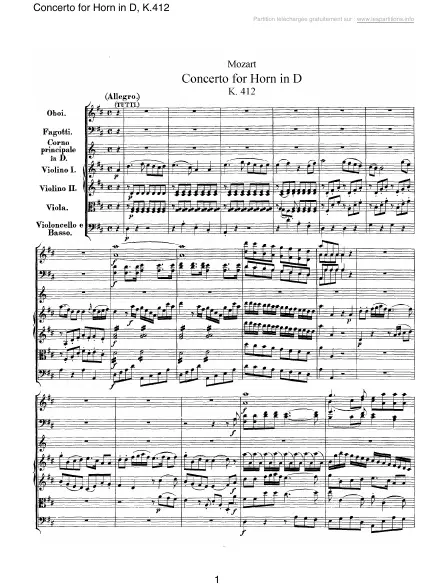
The Allegro begins with strings alone, joined by two oboes and two bassoons before the principal horn enters. The soloist mainly works with notes of the natural harmonic series, scales and calls, yet Mozart avoids a mere fanfare effect: piano replies, syncopation and bassoon lines keep the tutti mobile. Solo episodes remain transparent, often carried by regular violin quavers that leave the horn’s projection in the foreground.
At page eight, the Rondo Allegro changes the texture. Its horn refrain is immediately memorable while the strings maintain a hunting pulse in 6/8. The movement must nevertheless be read as Süssmayr’s realisation of Mozart’s plan: the solo part remains close to the outline, but the accompaniment and orchestral form are not an autograph completion. This documentary distinction is part of the score’s interest and should remain visible.
In rehearsal, the Allegro needs a careful balance between horn brilliance and bassoon detail. Attacks should grow from the air without hardening sustained notes. In the Rondo, retain two broad beats and keep string quavers light; a heavy tempo turns the hunt into a march. The soloist can also compare returns of the refrain to vary echoes and dynamics without pretending to erase the file’s composite history.
What the document containsDocument: The document contains 14 pages in PDF format. No MIDI file is currently attached to this historical record. The PDF has 14 pages. Pages 1-7 contain Mozart’s Allegro for principal horn, two oboes, two bassoons and strings; pages 8-14 contain the traditional Rondo Allegro, orchestrated by Franz Xaver Süssmayr from the K.412 outline and catalogued as K.514.The historical record marks the work and file as public domain but does not document the editor or exact provenance of this copy. The file preserved by LesPartitions.info can be compared with the reference catalogue. Following that check, LesPartitions.info separates established facts from information that remains incomplete.