About this work
The D-major Concerto K.314 was not first conceived for flute. Mozart had written a C-major concerto in 1777 for the Salzburg oboist Giuseppe Ferlendis; he reworked it for flute in Mannheim early in 1778 as part of the Dejean commission. Eighteenth-century parts transmit both states, while the autograph is lost. The transposition and adaptations are therefore not a later external arrangement but part of Mozart’s own exploration of the two instruments.
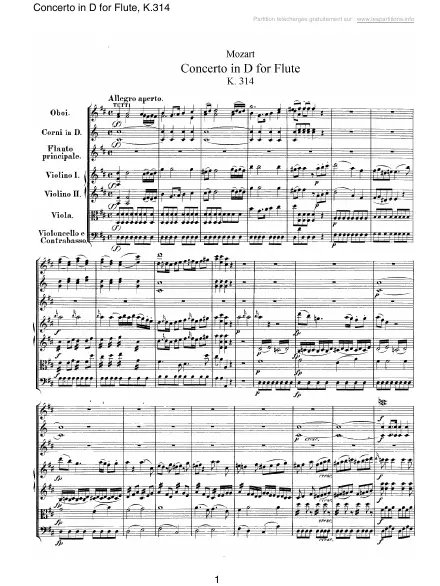
The Allegro aperto opens with a sharply articulated D-major tutti. Oboes, horns and strings present repeated notes, upward bursts and forte-piano oppositions. When the flute enters, it takes up some contours but extends them into long scales and more flexible figures. The movement thus alternates firm orchestral blocks with episodes in which the soloist continually shifts the centre of gravity, at times supported only by violins and bass.
The local full score calls the second movement Andante ma non troppo. In triple metre, with horns in G, it gives the flute ornamented lines above a more spacious accompaniment. The finale, marked simply Allegro in this file, returns to D major with a buoyant refrain, immediate violin replies and frequent changes between solo and tutti. Its vitality depends less on extreme speed than on the clarity with which motives move between partners.
For the soloist, the challenge is to distinguish oboe-like articulation from broad runs that lie naturally on the flute. Repeated notes in the first movement should remain spoken; ornaments in the Andante need harmonic direction. The finale requires very stable renewals of tempo after each cadence. With the orchestra, treat the many forte-piano markings as changes of perspective rather than isolated blows.
What the document containsDocument: The document contains 25 pages in PDF format. No MIDI file is currently attached to this historical record. The PDF is a complete 25-page full score: Allegro aperto, Andante ma non troppo and a final Allegro. It scores principal flute, two oboes, two horns and strings; the horns change from D to G in the slow movement.The historical record marks the work and file as public domain but does not document the editor or exact provenance of this copy. The file preserved by LesPartitions.info can be compared with the reference catalogue. Following that check, LesPartitions.info separates established facts from information that remains incomplete.