About this work
The Violin Concerto in B-flat major K.207 traditionally opens Mozart’s group of five concertos, but the New Mozart Edition separates it from the next four. Handwriting and paper evidence place its composition in 1773, whereas K.211, 216, 218 and 219 belong to 1775. This earlier date is heard less as immaturity than as a different way of organising dialogue: the principal violin remains close to the orchestral fabric before ornament and register allow it to step forward.
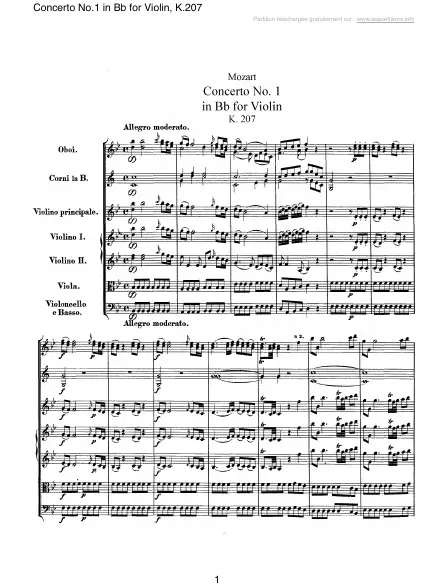
The Allegro moderato begins with a compact tutti for two oboes, two horns and strings. When the soloist enters, it takes up the shared material and expands it through runs, trills and climbs into the upper register. The contrast is therefore not between a hero and a crowd; it comes from the changing flexibility of the same idea. Regular figures in violas and basses preserve the pulse while the violin line gains freedom.
The Adagio in E-flat major slows the harmonic pace and lets the melody unfold over continuous string figures. Winds act as points of colour rather than as a second concertante group. The closing Presto restores a more nervous style, built from short replies, repetitions and rapid switches between solo and tutti. Its liveliness depends on clean articulation, not on a tempo that blurs each return of the motive.
When practising the solo part, first locate places where the violin doubles or extends an orchestral voice: these establish character and intonation before the brilliant passages. Sustain phrase endings in the Adagio without weighing down the beat. In the Presto, group runs according to cells heard in the orchestra and prepare trills within the pulse. The concerto then becomes a continuous conversation rather than a sequence of detached displays.
What the document containsDocument: The document contains 26 pages in PDF format. No MIDI file is currently attached to this historical record. The PDF is a 26-page full score containing the Allegro moderato, Adagio and Presto. It sets the principal violin against two oboes, two horns and strings; all three movements and their key changes are present, without separate parts.The historical record marks the work and file as public domain but does not document the editor or exact provenance of this copy. The file preserved by LesPartitions.info can be compared with the reference catalogue. Following that check, LesPartitions.info separates established facts from information that remains incomplete.