About this work
Mozart composed the Violin Concerto in D major K.211 in 1775, near the beginning of the sequence that would lead within a few months to the celebrated K.219. Its three-movement plan is compact, yet the violin already speaks with great vocal flexibility. Virtuoso formulas are not pasted onto the line: they extend the appoggiaturas, trills and small repetitions that give it the accent of conversation.
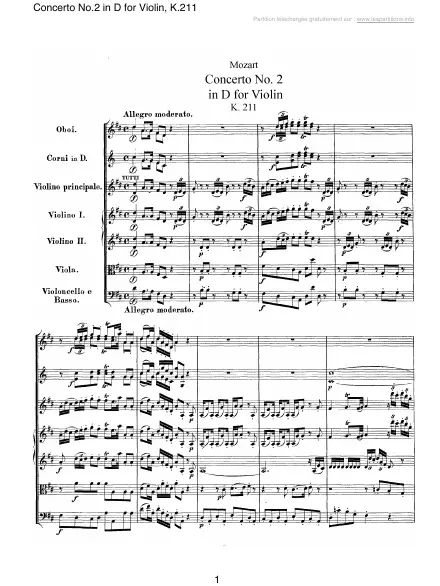
In the Allegro moderato, the orchestra presents a clear theme punctuated by oboes and horns. The soloist takes up its profiles without merely copying them: it connects silences, shifts cadential weight and keeps energy moving through rapid runs. Basses maintain a regular tread, allowing the violin to play with anticipation and delay without losing the bar. Returns of the tutti are structural landmarks rather than rests between solos.
The Andante lightens the texture still further. The violin melody rests on a discreet accompaniment and must keep its direction through numerous ornaments. The closing Rondeau. Allegro begins from a short, balanced refrain; changes of register, orchestral replies and runs leading back to the cadence animate each return. The aim is not to make every episode faster, but to let the listener recognise the refrain beneath its altered outlines.
An effective rehearsal begins with bass lines and the ends of tuttis. Add the solo while preserving the same points of arrival, especially in semiquaver sequences. In the Andante, allow the line to sing without applying automatic vibrato to every long note; in the rondo, distinguish refrain from transition through articulation. This hierarchy reveals the work’s concision and prevents it from sounding uniform.
What the document containsDocument: The document contains 22 pages in PDF format. No MIDI file is currently attached to this historical record. The 22-page full score contains the three movements listed by the New Mozart Edition: Allegro moderato, Andante and Rondeau. Allegro. The principal violin converses with two oboes, two horns and strings; no separate part is included.The historical record marks the work and file as public domain but does not document the editor or exact provenance of this copy. The file preserved by LesPartitions.info can be compared with the reference catalogue. Following that check, LesPartitions.info separates established facts from information that remains incomplete.