About this work
The Violin Concerto in D major K.218 belongs to the group of 1775 concertos whose autographs survive. Its key and opening calls give it a brilliant bearing, yet Mozart avoids a consistently martial tone. The solo part quickly turns the tutti’s firm gestures into flexible lines, appoggiaturas and runs that appear to extend rather than interrupt the phrase. The New Mozart Edition even preserves an earlier ending of the slow movement and a deleted passage from the finale in its appendix, evidence of the revision process.
The Allegro rests on a contrast between orchestral chords and dotted rhythms, then the continuity of the principal violin. Oboes and horns mark large structural joints, while strings often support the solo with regular figures. In the Andante cantabile, virtuosity recedes in favour of a long line: the difficulty is to let appoggiaturas breathe without losing harmonic direction.
The Rondeau begins Allegro grazioso but does not keep a single gait. An Allegro ma non troppo section brings a more direct profile, then Andante grazioso restores a measured motion before the refrain returns. These changes do not form a collage. Related melodic outlines and cadences pass from one character to another, allowing the soloist to change tone while preserving the listener’s memory of the form.
The first movement needs clean attacks without hardness and a clear distinction between structural notes and ornaments. In the Andante, practise the line over basses alone to hear where it is going. In the finale, mark tempo transitions in the orchestral part as carefully as in the solo: each change should be prepared by the end of the preceding phrase. This continuity gives the concerto nobility without stiffness.
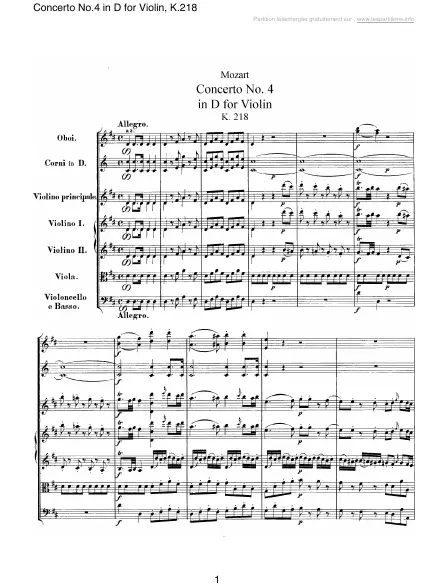
What the document containsDocument: The document contains 30 pages in PDF format. No MIDI file is currently attached to this historical record. The 30-page full score contains the Allegro, Andante cantabile and Rondeau with its Allegro grazioso, Allegro ma non troppo and Andante grazioso markings. The forces are principal violin, two oboes, two horns and strings.The historical record marks the work and file as public domain but does not document the editor or exact provenance of this copy. The file preserved by LesPartitions.info can be compared with the reference catalogue. Following that check, LesPartitions.info separates established facts from information that remains incomplete.