About this work
La clemenza di Tito was written for the celebrations surrounding Leopold II’s coronation as King of Bohemia. The opera was first performed at Prague’s National Theatre on 6 September 1791, only weeks before The Magic Flute. Caterino Mazzolà reshaped Metastasio’s old libretto for Mozart, turning it, in the composer’s catalogue phrase, into a “true opera”. The overture must therefore serve a ceremonial function, yet it is not merely an official portrait: beneath the brilliance of C major, tension and highly theatrical mobility keep circulating.
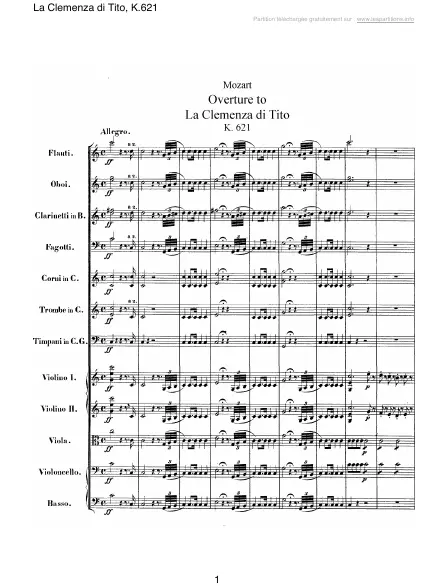
The Allegro begins fortissimo with flutes, oboes, clarinets, bassoons, horns, trumpets, timpani and strings. Triplets in winds and strings immediately soften the repeated chords. Short pauses divide statements, after which a piano passage gives the violins more movement. The opposition between collective proclamation and rapid figures suits the opera’s subject, where Titus’s authority exists only through the choices, faults and reactions of those around him.
The central pages multiply exchanges: chromatic string runs, bassoon arpeggios, woodwind chords and renewed violin motion. Some bars leave almost the whole upper orchestra silent while the strings prepare another surge. The ending gathers the opening triplets, scales and chords, yet still includes piano withdrawals before the last tutti. This breathing prevents grandeur from becoming uniform.
In rehearsal, triplets must retain the same subdivision in strings and winds, especially when they answer one another. Do not spend all the available volume in the opening bars: the many fortissimo returns need hierarchy. Practise chromatic passages by instrumental groups with shared destinations. In the conclusion, trumpet and timpani attacks should reinforce the strings without covering the figures that continue to circulate.
What the document containsDocument: The document contains 11 pages in PDF format. No MIDI file is currently attached to this historical record. The PDF is an 11-page full score containing the complete Allegro. The scored forces are two flutes, two oboes, two clarinets in B flat, two bassoons, two horns and two trumpets in C, timpani in C and G, and strings; it includes neither voices nor separate parts.The historical record marks the work and file as public domain but does not document the editor or exact provenance of this copy. The file preserved by LesPartitions.info can be compared with the reference catalogue. Following that check, LesPartitions.info separates established facts from information that remains incomplete.