About this work
Mozart received the commission for Idomeneo in 1780 for the Munich carnival season. He already knew the players who had come from the former Mannheim court and could write for an orchestra whose precision and colours he admired. The opera was first performed on 29 January 1781. Its overture is not a digest of tunes from the stage work: it immediately creates a world where royal splendour is crossed by anxiety, matching a drama about a king bound by an impossible vow.
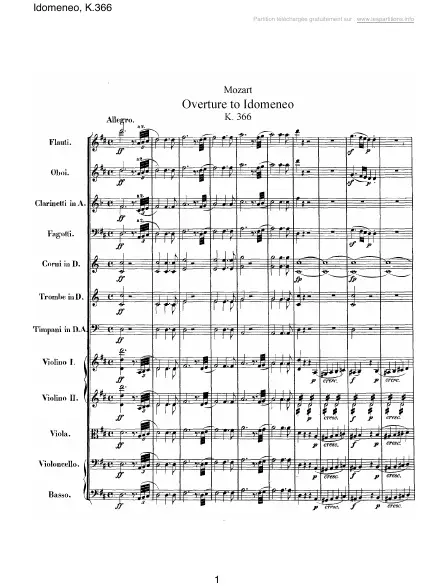
The D-major Allegro begins fortissimo with a short triplet figure stated together by flutes, oboes, clarinets, bassoons, horns, trumpets, timpani and strings. This mass almost immediately breaks apart. Piano replies, rising scales and transfers between winds and strings prevent ceremonial weight from settling. The contrasts are not decorative: they alternate public assertion with more mobile agitation, often keeping an insistent bass beneath changing orchestral colours.
In the middle of the full score, chromatic writing and syncopation make the harmony less secure. First violins launch runs that other sections extend or contradict; elsewhere, winds sustain long notes while repeated quavers in the strings preserve motion. The final page concentrates these elements, multiplies trills and recovers a brilliant D major. The overture closes decisively, yet the energy it has gathered prepares the opera’s conflict rather than a simple celebration.
In rehearsal, genuinely structural chords need to be distinguished from the many passing accents. The opening triplets should be incisive without becoming heavy, and piano replies must retain the same pulse. Practise the central pages by following bass lines first and then wind entries: their instability becomes intelligible. The conclusion finally requires coordinated trills and shared releases, otherwise orchestral brilliance will obscure the dramatic design.
What the document containsDocument: The document contains 11 pages in PDF format. No MIDI file is currently attached to this historical record. The PDF is an 11-page full score containing the complete Allegro. The scored forces are two flutes, two oboes, two clarinets in A, two bassoons, two horns and two trumpets in D, timpani in D and A, violins, violas, cellos and double basses; no separate parts are included.The historical record marks the work and file as public domain but does not document the editor or exact provenance of this copy. The file preserved by LesPartitions.info can be compared with the reference catalogue. Following that check, LesPartitions.info separates established facts from information that remains incomplete.