About this work
The Abduction from the Seraglio is the major German Singspiel Mozart composed for Joseph II’s court theatre in Vienna. Its first performance took place on 16 July 1782. The plot combines adventure, comedy and forgiveness around Europeans held in Pasha Selim’s palace. From the overture, Mozart links this theatrical setting with the “Turkish music” imagined by Viennese Europe at the time: not an ethnographic reconstruction, but a stage colour built from a piercing upper register and percussion unusual in the orchestra.
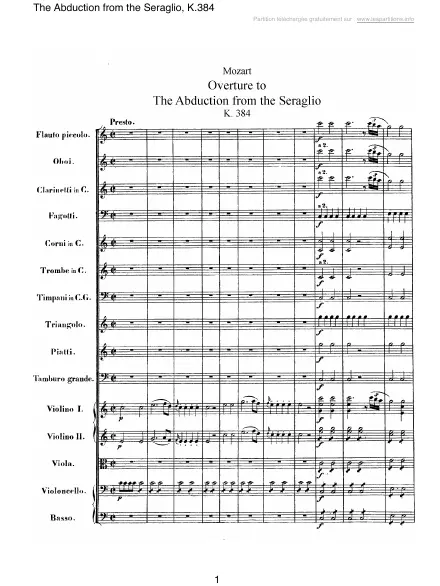
The C-major Presto begins with light motion in the strings, soon crossed by piccolo, oboes, clarinets and bassoons. Trumpets, timpani, triangle, cymbals and bass drum give the large returns their brilliance. The challenge is to hear several planes: the battery marks structural pillars, while rapid motives travel through woodwinds and violins. If every accent receives equal weight, the music merely becomes noisy; when runs retain their articulation, it preserves its comic wit.
At the centre, a minor-key Andante in triple metre removes piccolo, trumpets and percussion. Strings play piano, punctuated by oboes, clarinets and bassoons. This parenthesis does more than slow the pace: it introduces an anxious tenderness, reminding us that the opera also concerns separation and fidelity. Tempo I then restores the Presto and its full colour, leading to a fortissimo conclusion in which the percussion joins the orchestra’s chords.
In rehearsal, begin the Presto without percussion to establish articulations and wind replies. Add triangle, cymbals and bass drum as a layer of colour without covering syncopations or bass lines. Dynamic changes and small silences in the Andante should breathe without breaking the bar. The return of Tempo I will sound more theatrical if it recovers the exact opening pulse rather than starting faster.
What the document containsDocument: The document contains 32 pages in PDF format. No MIDI file is currently attached to this historical record. The 32-page full score moves through Presto, Andante and Tempo I. It is scored for piccolo, two oboes, two clarinets in C, two bassoons, two horns and two trumpets in C, timpani, triangle, cymbals, bass drum and strings; percussion and brass fall silent in the central Andante.The historical record marks the work and file as public domain but does not document the editor or exact provenance of this copy. The file preserved by LesPartitions.info can be compared with the reference catalogue. Following that check, LesPartitions.info separates established facts from information that remains incomplete.