Free sheet music
Symphonie concertante pour violon et alto en Mi b majeur K 364
About this work
Mozart wrote the Sinfonia concertante in E-flat major K.364 in Salzburg during the summer or early autumn of 1779, after returning from Mannheim and Paris, where the concertante genre held an important place. The title does not describe an ordinary concerto with two soloists: violin and viola form a pair that completes, resumes or contradicts a shared phrase. The orchestra retains a genuinely symphonic presence and never becomes mere accompaniment.
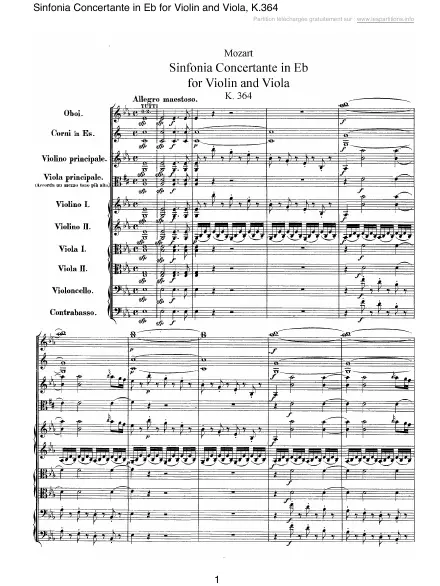
The Allegro maestoso first establishes orchestral breadth, then the two soloists enter by bringing their timbres together. Mozart asks the viola to be tuned a semitone higher; its part is therefore notated in D major to sound in E-flat. This scordatura increases string tension and helps the instrument project beside the violin. The difference in notation makes the device visible in the full score before its effect is heard.
The Andante in C minor turns the dialogue into a grave scene. The instruments exchange short phrases, join in thirds or sixths, then separate again; orchestral silences give weight to every return. Cadenzas extend this conversation rather than establishing a contest. The closing Presto releases energy in rapid motion, with motives passing constantly from violin to viola and back to the tutti.
The central ensemble task is to unify attacks and releases without erasing each instrument’s personality. In the Andante, both soloists should breathe together even when their lines differ. In the Presto, rehearse handovers before joining longer phrases and monitor the viola’s intonation under its special tuning. Success comes from reciprocal listening: neither soloist should sound as though it merely accompanies the other.
What the document containsDocument: The document contains 62 pages in PDF format. No MIDI file is currently attached to this historical record. The PDF is a 62-page full score containing the Allegro maestoso, Andante and Presto. It separately notates principal violin and viola with two oboes, two horns and strings; the instruction to tune the solo viola a semitone higher appears in the score.The historical record marks the work and file as public domain but does not document the editor or exact provenance of this copy. The file preserved by LesPartitions.info can be compared with the reference catalogue. Following that check, LesPartitions.info separates established facts from information that remains incomplete.