About this work
Mozart entered the Symphony in C major K.551 in his catalogue on 10 August 1788, at the end of the group formed with K.543 and K.550. The occasion for which these final three symphonies were conceived is unknown, and no performance of K.551 during the composer’s lifetime can be documented with certainty. The nickname “Jupiter”, absent from Mozart’s manuscript, became established later. It suits the work’s breadth, yet it can obscure its mobility: grandeur is repeatedly interrupted by a lighter reply, a silence or a change of texture.
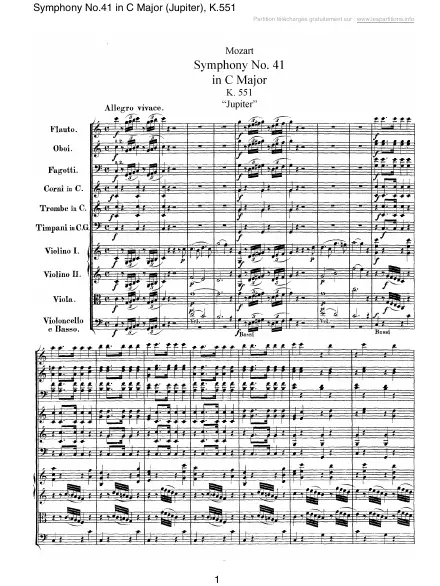
The Allegro vivace opens with three sharply separated gestures: a firm orchestral call, a more singing answer, then a quick renewal in the strings. This clear-cut sequence governs the movement. Trumpets and timpani give weight to structural pillars, while flute, oboes and bassoons soften transitions. In the Andante cantabile, muted strings create a gentleness unsettled by accents, silences and chromatic turns. The Menuetto retains the bearing of a dance, but its overlapping entries already prepare the contrapuntal work of the finale.
The closing Molto allegro begins with a very simple four-note cell and introduces several others: repeated notes, rapid runs and more lyrical figures. Mozart does not merely place them side by side. He inverts and displaces them, finally allowing them to sound together in a contrapuntal coda where every section keeps its own course. The listening challenge is to follow several lines without reducing the passage to a brilliant mass. Basses and inner voices matter as much as the violins’ high profile.
In rehearsal, the opening chords benefit from being short and full rather than heavy. The Andante needs breathing space beneath its syncopations, and the Menuetto should not be stalled by an overemphatic downbeat. The finale ultimately depends on shared articulation between strings and winds. Locate each motif separately in the full score, then follow its transfers between sections: the conclusion draws its power from precise interlocking, not from a general rush.
What the document containsDocument: The document contains 56 pages in PDF format. No MIDI file is currently attached to this historical record. The 56-page full score contains all four movements: Allegro vivace, Andante cantabile, Menuetto. Allegretto and Molto allegro. The scored forces are flute, two oboes, two bassoons, two horns, two trumpets, timpani and strings, without clarinets.The historical record marks the work and file as public domain but does not document the editor or exact provenance of this copy. The file preserved by LesPartitions.info can be compared with the reference catalogue. Following that check, LesPartitions.info separates established facts from information that remains incomplete.