About this work
Mozart composed The Magic Flute for Emanuel Schikaneder’s popular theatre in Vienna. The first performance took place on 30 September 1791, two days after the composer entered the overture in his catalogue. The New Mozart Edition notes that the three solemn chords were added late, together with part of the instrumentation. They are not a code to be translated mechanically: within the opera they belong to a world of trial, listening and community, opposed to the characters’ immediate reactions.
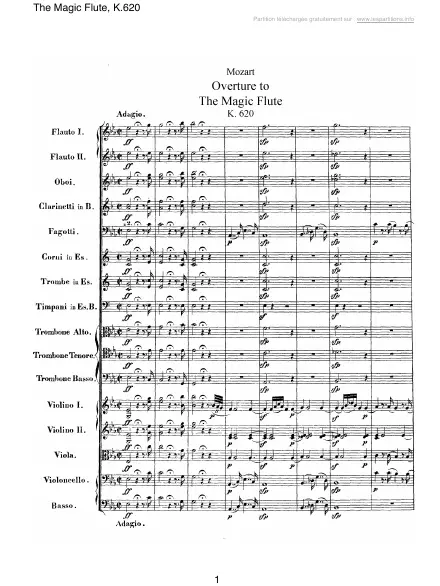
The E-flat major Adagio opens with the whole orchestra, including three trombones that double and deepen the lower voices. Fortissimo chords are separated by silences and followed by softer replies in strings and bassoons. The Allegro then begins piano with a lively subject in the violins, soon taken up and superimposed by other sections. This contrapuntal writing should not sound academic: every entry adds another participant to a conversation that gradually engages the entire orchestra.
At the centre of the overture, the three chords return in a new Adagio. Motion is suspended, after which the Allegro resumes with different distributions of the subject, scales and woodwind replies. Flutes, oboes, clarinets and bassoons may carry the line while strings preserve momentum. The final page gathers rapid figures and chords, increasing not the tempo but the frequency of exchanges until the full, luminous conclusion.
In rehearsal, the three chords need the same collective weight and genuinely inhabited silences. Locate every entry of the Allegro subject before playing at tempo; basses, violas and second violins are never mere filling. Distinguish repeated notes from lines that cross the texture, then build crescendos by adding sections. The return of the Adagio will be more striking if nobody slows before the bar in which it is marked.
What the document containsDocument: The document contains 26 pages in PDF format. No MIDI file is currently attached to this historical record. The 26-page full score contains Adagio, Allegro, the central return of the Adagio and the resumed Allegro. The forces are two flutes, two oboes, two clarinets in B flat, two bassoons, two horns and two trumpets in E flat, timpani, three trombones and strings.The historical record marks the work and file as public domain but does not document the editor or exact provenance of this copy. The file preserved by LesPartitions.info can be compared with the reference catalogue. Following that check, LesPartitions.info separates established facts from information that remains incomplete.