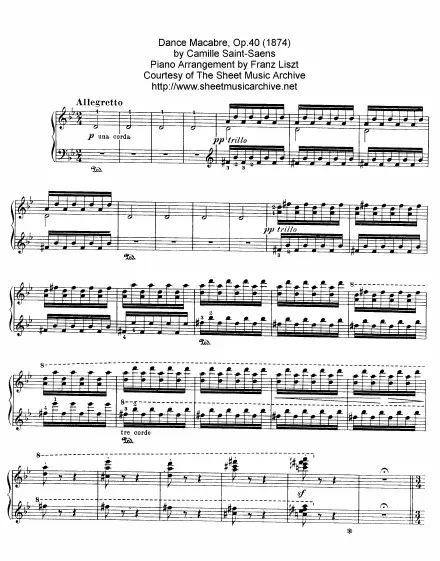
About this work
Danse macabre began as a symphonic poem by Saint-Saëns: midnight strikes, the violin sounds its grating interval and the skeletons enter the dance, supported by an orchestra in which the xylophone provides its famous clatter. Franz Liszt later compressed the scene into a piano transcription. Two hands must persuade us that several orchestral sections are playing.
Before tackling the virtuoso runs, mark the episodes in the story and the returns of the dance theme. Assign a timbre to each line in your mind: dry attacks for percussion effects, a more biting song for the violin, deep but short bass notes for the orchestra. This prevents every note from receiving the same force. In octaves and chords, prepare shifts in blocks and keep the wrist flexible.
The pedal must gather resonances without dissolving the characteristic intervals. Practise the layers slowly, then increase the tempo by complete sections rather than isolated fragments. Silences and withdrawals are part of the theatre: if everything stays loud, the final appearance of daylight changes nothing. The transcription demands power, but succeeds chiefly through differentiated voices.
What the document containsFranz Liszt’s piano transcription, catalogued as S 555;a complete 21-page PDF in a ZIP archive;no accompanying MIDI file.The file is not Saint-Saëns’s original orchestral score.