About this work
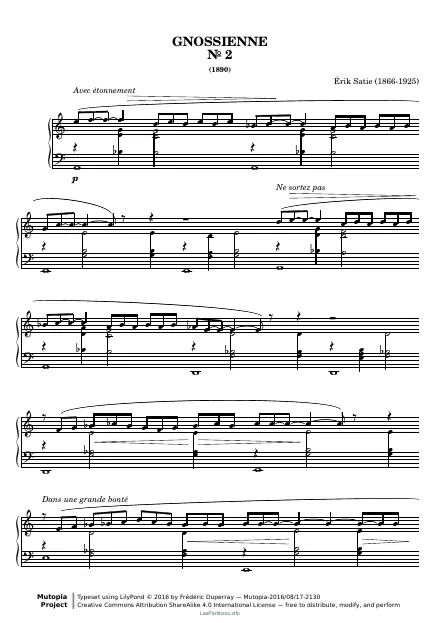
In the second Gnossienne, the melody moves in small groups above sustained bass notes and widely spaced chords. Satie’s opening direction, “Avec étonnement” (with astonishment), accompanies repeated pitches and ties that prolong the sound without adding new attacks. The left hand maintains this suspended feeling while letting the harmony change beneath it.
The engraving shows neither ordinary bar lines nor a time signature. At the opening, count the first three eighth-note beats in the right hand. The first left-hand chord lines up with the held E that follows. Find that alignment on the page before putting the hands together. Several sharps enter at “Plus intimement” (more intimately); identify their new colours before trying to blend them with the pedal.
First play the bass and melody together, then add the chords at a softer level. Renew the pedal as the harmony changes, listening to the bass that remains. “Dans une grande bonté” (with great kindness) and “Sans orgueil” (without pride) suggest changes of character. At the pianissimo ending, concentrate on keeping the sustained chord connected.
Score and files
Solo piano score: a 2-page PDF typeset by Frédéric Duperray for Mutopia, with MIDI. The stated printed source is the 1913 Rouart, Lerolle & Cie edition, possibly consulted in a Dover reprint. This engraving uses the CC BY-SA 4.0 licence, requiring attribution and the same licence for adaptations. Satie’s composition is in the public domain. The PDF uses the Mutopia engraving with a LesPartitions.info link at the foot of each page.
LesPartitions.info