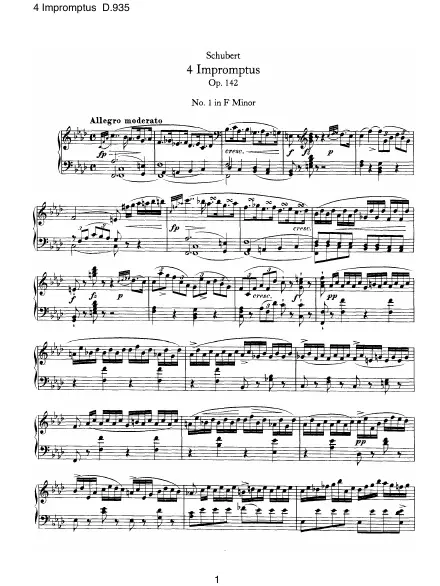
About this work
The four Impromptus D 935 are not four versions of the same gesture. Schubert composed them in 1827 as a strongly contrasted group: an expansive first impromptu in F minor, a second moving at the measured pace of a minuet, a third built as variations and a rhythmically driven finale returning to F minor. Their posthumous publication as Op. 142 should not obscure the coherence of the cycle.
The first requires broad arches despite its returns and changes of light. In the second, a restrained tempo allows accents and breaths to speak more eloquently than emphatic rubato. In the third, keep recognising the theme beneath each new texture: ornaments, shifts of register and added density must never erase its proportions. The fourth needs a firm pulse and a hand that rebounds instead of striking.
When studying the set, give each piece a different objective rather than running the whole volume under the same conditions. Mark the structure of the first, sing the inner voices of the second, compare the variations in the third and reduce the finale to its rhythmic supports. Once these landmarks are in place, the transitions grow more natural and the cycle stops resembling a list of difficulties.
What the document containsall four Impromptus D 935;a 30-leaf score in PDF format;no accompanying MIDI file.The volume contains the complete D 935 set, not a single impromptu.