About this work
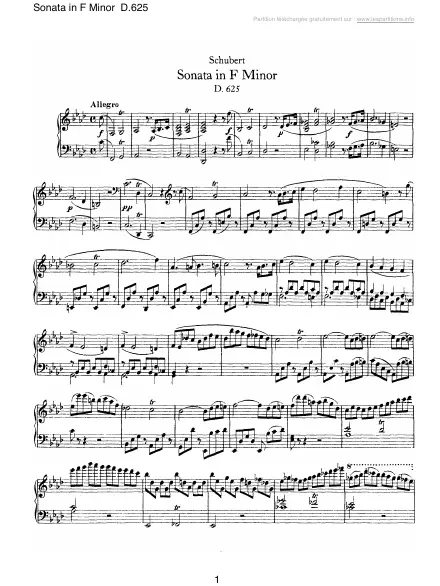
The Sonata in F minor, D.625, does not reach us as a reassuringly finished cycle. Fragments of movements stand beside a complete Scherzo and Trio. That discontinuity does not conceal the firmness of the musical thought: dotted rhythms, contrasts of register, and harmonic surges give the score a dark energy that is often more abrupt than dreamy.
Practise each section according to its own trajectory before seeking an overall unity. In the dramatic passages, keep the rhythm exact without thickening the chords. The Scherzo benefits from mobility, with accents that bite and immediately withdraw; the Trio calls instead for a released gesture and longer attention to resonance.
The breaks visible in the source must remain breaks. Resist the temptation to slow down automatically before every interruption or to invent a cadence that would imply a composed ending. A steady pulse and clearly directed reprises provide enough continuity for performance while respecting the fragmentary condition of the sonata.
What the document containsthe fragments, Scherzo, and Trio of the Sonata D.625;a 14-page PDF for solo piano;no accompanying MIDI file.The document preserves the gaps in the work and does not present a complete reconstruction.