About this work
“Quatre marches Op. 76” combines clear attacks with continuity, under the fingers. form steadies motif; harmony prepares inner voice, then contrasts renews a clear reading.
Under the fingers, secondary voices prepare the principal changes. inner voice steadies form when you rehearse transitions out of context before reconnecting them.
Under the fingers, rank accents instead of reinforcing every one. contrasts prepares harmony; motif renews inner voice and the direction remains continuous. These four marches share neither the same weight nor the same character. Compare upbeats, dotted rhythms, bass lines and trios; a common metre must never produce four identical articulations. Practise chords as directed impulses, then adjust releases to the piano’s resonance. In homorhythmic passages, seek depth without letting the thumbs dominate; lighter episodes instead require immediate rebound. Finally record one complete march to check proportions among returns, trios and conclusions. Each transition into a trio should alter the sound space before the new theme begins.
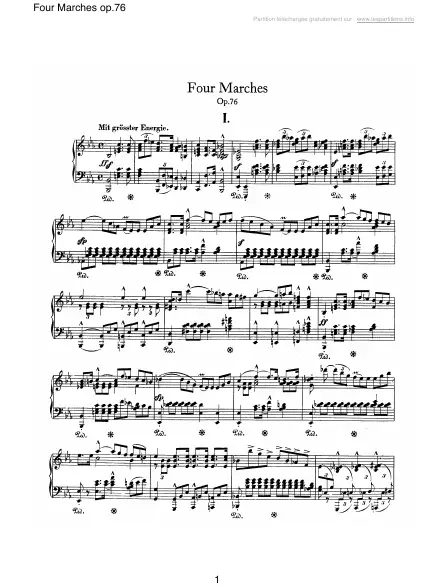
What the document containsDocument: The document contains 16 pages in PDF format. No MIDI file is currently attached to this historical record.The historical record marks the work and file as public domain but does not document the editor or exact provenance of this copy. The file preserved by LesPartitions.info can be compared with the reference catalogue. Following that check, LesPartitions.info separates established facts from information that remains incomplete.