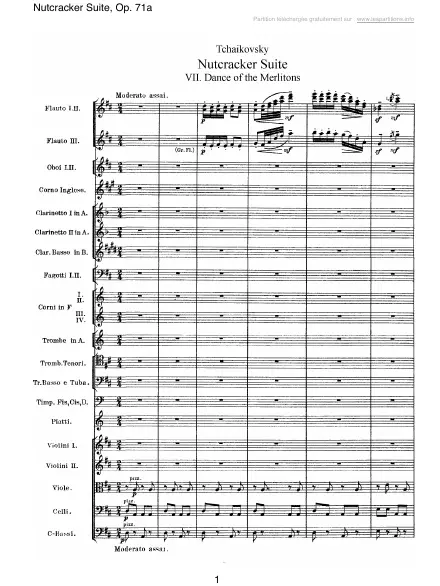
About this work
In Act II of The Nutcracker, the Dance of the Mirlitons brings pastoral elegance to the entertainment in the Kingdom of Sweets. Three flutes unfold the D-major theme above light strings, with precise articulation suggesting small reed instruments or toy flutes. Tchaikovsky later included the number in the concert suite Op. 71a.
Its charm comes from the contrast between the accompaniment’s almost mechanical regularity and the flexibility of the flute phrases. The central section briefly darkens the colour and thickens the orchestra before the theme returns. Preserve this shift in perspective: if everything remains uniformly graceful, we get a pretty music box but lose the scene.
In rehearsal, begin by tuning the three flutes on long notes and motif endings. The strings should lighten their attack without losing the pulse, while the supporting woodwinds colour the transitions. Too quick a tempo makes the runs sharp; too slow a tempo turns the mirlitons into an administrative department. Find a dancing motion that leaves each repeat with some momentum.
What the document contains
the Dance of the Mirlitons from the ballet The Nutcracker;
a 9-page orchestral score;
a PDF, with no separate parts or MIDI file.
The document is a full score. It does not contain the complete set of individual orchestral parts.