About this work
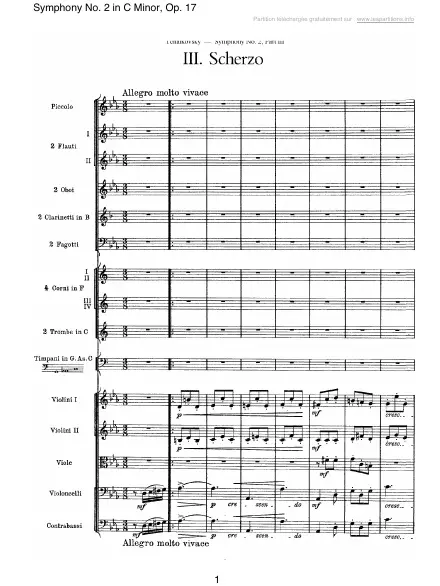
The movement is driven by short, springing energy that is continually renewed. From the start of the Allegro molto vivace, motives pass rapidly between strings and woodwinds, with accents that keep shifting the point of support. The scherzo’s vigour comes not from constant mass but from an alternation of bursts, withdrawals and tightly timed replies.
The trio creates a more stable space and a different quality of motion without stopping the overall flow. The score reveals the precision with which Tchaikovsky redistributes functions: the same impulse may become accompaniment, counterpoint or a signal of transition. The returns draw their effectiveness from this shared rhythmic memory.
Ensemble work should aim for clean attacks and continuity as material changes hands. If every section stresses its own part in isolation, the larger line breaks apart; when the replies are shaped as one phrase, the movement gains depth. The final return can then recover its vivacity without sounding like a mechanical repetition.
What the document containsDocument: The document contains 31 pages in PDF format. No MIDI file is currently attached to this historical record. The PDF contains the complete orchestral score of this movement across 31 pages.The historical record marks the work and file as public domain but does not document the editor or exact provenance of this copy. The file preserved by LesPartitions.info can be compared with the reference catalogue. Following that check, LesPartitions.info separates established facts from information that remains incomplete.