About this work
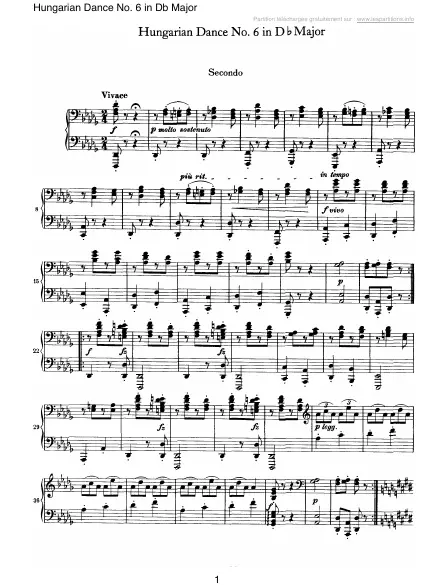
The sixth Hungarian Dance in D-flat major is a Vivace built around the art of stopping and starting again. Fermatas and più ritardando markings interrupt the opening momentum, which is immediately relaunched in tempo. A degree of surprise must remain: if every suspension lasts exactly the same amount, the dance becomes mechanical.
A central Molto sostenuto broadens the line before the initial Vivace returns. Its 123 bars alternate emphatic chords, octaves, quick runs and more connected phrases. The secondo often determines rhythm through basses and chords; the primo adds ornaments and wide shifts. Both players must nevertheless breathe together at every fermata.
Decide who leads each stop and which silent pulse continues during the suspension. Rehearse in-tempo recoveries from the preceding bar rather than counting only at the new entry. Lighten accompaniment and give long values direction in Molto sostenuto. The final Vivace should recover the opening liveliness with more secure, relaxed articulation.
What the document containsDocument: The document contains 6 pages in PDF format. No MIDI file is currently attached to this historical record. The six-page PDF contains all 123 bars in separate secondo and primo parts, including the central Molto sostenuto and the return of the Vivace.The historical record marks the work and file as public domain but does not document the editor or exact provenance of this copy. The file preserved by LesPartitions.info can be compared with the reference catalogue. Following that check, LesPartitions.info separates established facts from information that remains incomplete.