About this work
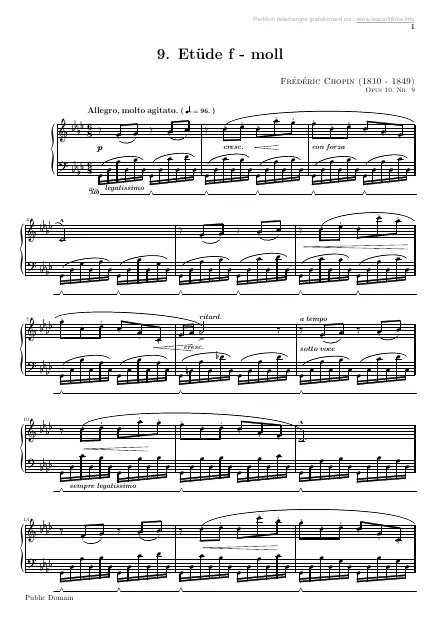
In Étude Op. 10 No. 9, movement begins in the left hand. Its broken figures travel continuously through the lower and middle registers beneath a right-hand melody made of short calls, silences and replies. F minor, 6/8 metre and the direction Allegro, molto agitato create persistent unrest, yet the broad slurs show that the bass needs to remain supple and directed rather than hammered.
Returns of the opening motif alternate with increasingly urgent episodes. Ritardandos and a tempo recoveries frame the first relaxations; later, stretto, accelerando, appassionato and sharp dynamic contrasts tighten the argument. The right hand develops from isolated notes into more assertive octaves and chords. This progression works only when the underlying 6/8 swing remains perceptible as the texture grows denser.
In the left hand, group semiquavers by harmony and aim for the first note of each pattern rather than all six notes separately. Then practise the melody with only the principal bass notes to place its breaths. When combining the hands, keep the left thumb light and prepare transfers during the right hand’s longer values. Tightening directions must grow from a controlled pulse; decide on a precise arrival tempo so that acceleration remains shaped and can be reversed.
What the document containsDocument: The document contains 4 pages in PDF format. A MIDI file also helps locate the continuity and entries. The PDF has 4 pages and contains the complete F-minor study in 6/8, with 66 bars, detailed tempo directions and fingering.The local PDF comes from an older Mutopia engraving placed in the public domain. The current Mutopia record preserves the revised LilyPond source, MIDI and corresponding PDF files. The file preserved by LesPartitions.info can be compared with the reference catalogue. Following that check, LesPartitions.info separates established facts from information that remains incomplete.