About this work
Don Giovanni, Mozart’s second collaboration with Lorenzo Da Ponte, was first performed in Prague on 29 October 1787 after several postponements. Its subtitle, “the rake punished”, announces a work in which comedy repeatedly collides with judgement and death. The overture condenses this duality without presenting a catalogue of arias. Its D-minor Andante evokes the world of the Commendatore and the final scene; the D-major Molto Allegro then begins a race full of evasions and abrupt changes of direction.
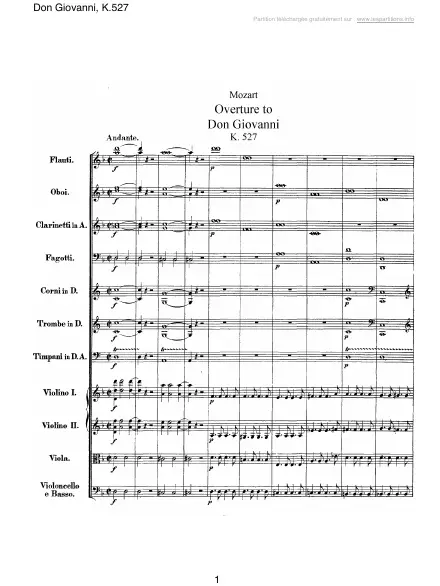
The opening chords engage the whole orchestra with trumpets and timpani, after which long wind notes dominate dotted and chromatic figures in the low strings. Silences and piano dynamics do not truly relax the atmosphere: they enlarge the space between calls. At the end of the Andante, chromatic crescendos in the violins are superimposed on sustained chords before the Molto Allegro begins with almost no transition.
The fast section rests on quavers in the strings, syncopations, descending runs and replies that constantly change section. Woodwinds may direct the phrase while violins sustain the pulse, after which the roles are reversed. This file ends with a self-contained orchestral cadence in D major. It therefore presents the concert ending, not the stage transition that leads directly into the opera’s first scene.
In rehearsal, the Andante needs exact note lengths and genuinely gradual crescendos: a premature fortissimo destroys its menace. In the Molto Allegro, practise syncopations with the bass and mark every transfer of the motive between instrumental families. Not all runs have the same function; some launch a phrase and others close a transition. The concert ending should finally conclude with clarity without turning vivacity into weight.
What the document containsDocument: The document contains 16 pages in PDF format. No MIDI file is currently attached to this historical record. The 16-page full score contains the D-minor Andante, the D-major Molto Allegro and its concert conclusion. It is scored for two flutes, two oboes, two clarinets in A, two bassoons, two horns and two trumpets in D, timpani in D and A, and strings; it includes neither voices nor the first scene.The historical record marks the work and file as public domain but does not document the editor or exact provenance of this copy. The file preserved by LesPartitions.info can be compared with the reference catalogue. Following that check, LesPartitions.info separates established facts from information that remains incomplete.